Philosophers and humanities
WHAT YOU FIND. Open questions about shared life, dignity, responsibility and memory; the 12 worlds as a working map.
HOW TO TAKE PART. Challenge a concept, propose a better question, write in the Courtyard.
START HERE · 5 MINUTES
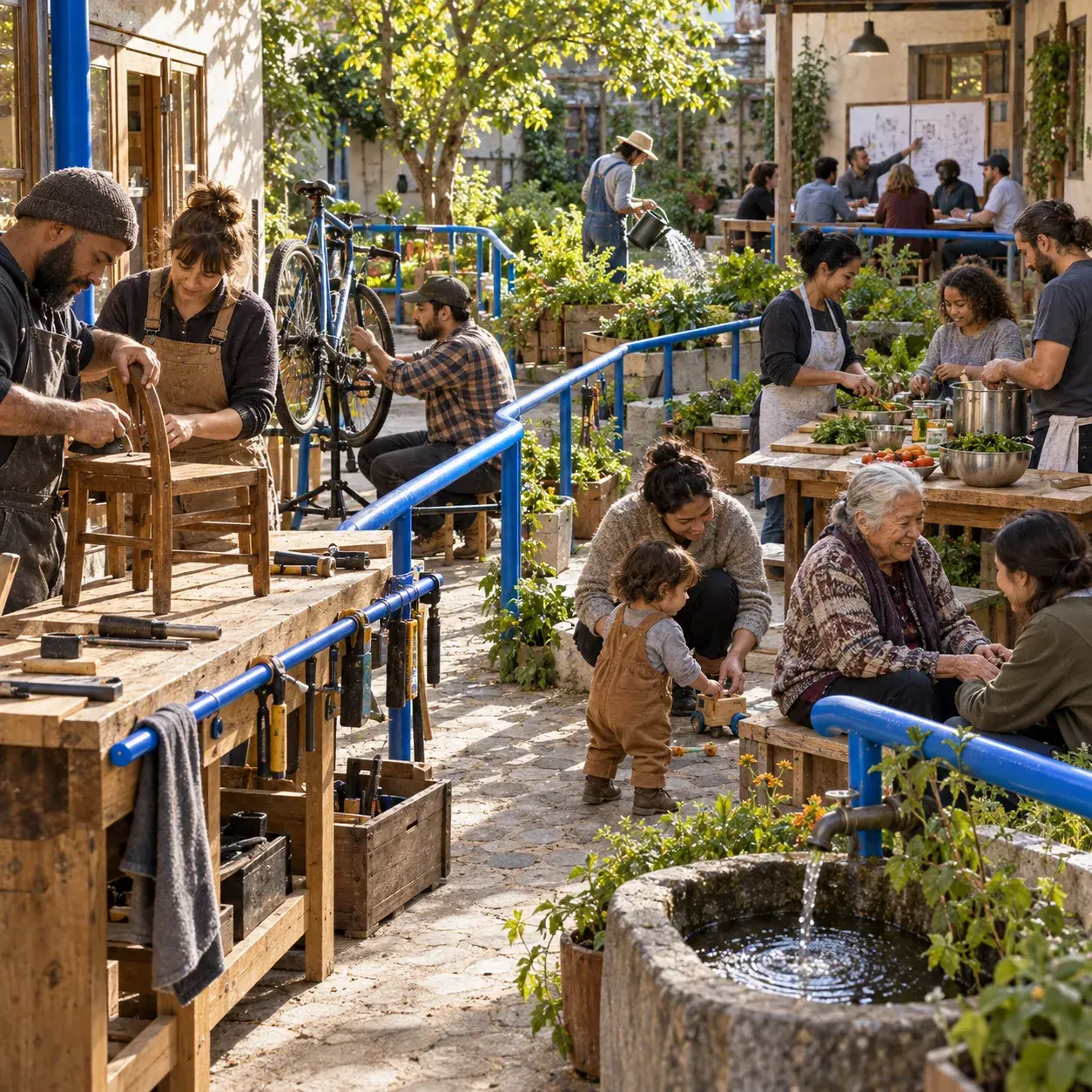
Communal Culture of Life is a planetary way of thinking about living together, starting from the apartment building. Here is who it is for, what it is and is not, and how to take part.
WHAT YOU FIND. Open questions about shared life, dignity, responsibility and memory; the 12 worlds as a working map.
HOW TO TAKE PART. Challenge a concept, propose a better question, write in the Courtyard.
WHAT YOU FIND. Sources with passports, the open method and data of the Observatory, and the gaps we admit.
HOW TO TAKE PART. Propose an indicator for worlds 10 and 12, correct a number, suggest a source.
WHAT YOU FIND. A technology radar arranged by the 12 worlds, and the question of what a house, a street and a city may become.
HOW TO TAKE PART. Send a signal or a scenario; challenge our statuses.
WHAT YOU FIND. A neutral, sourced picture of the conditions of life in common, every figure traceable. No mandate, no lobbying.
HOW TO TAKE PART. Share open data, host a conversation, propose a local node, or simply ask a question.
BRIEFING FOR INSTITUTIONS →OBSERVATORY OF LIFE IN COMMON →LET’S TALK →
WHAT YOU FIND. A radar that lists tools without endorsing them, and the concept of a resident's assistant that serves residents rather than managers.
HOW TO TAKE PART. Offer open data or open tools, or challenge a claim in the radar. No sponsorship is implied.
AI TERMS FOR INSTITUTIONS →BRIEFING FOR INSTITUTIONS →TECHNOLOGY RADAR →LABORATORY →
WHAT YOU FIND. Principles for living together, from the house to the planet, and a place to talk.
HOW TO TAKE PART. Leave a note, introduce yourself, write to a neighbour in another country.
WHAT YOU FIND. Images, stories and sources you can cite; a map of places and practices.
HOW TO TAKE PART. Tell a local story, propose a node, review a translation.
WHAT YOU FIND. Plain-language guides to each world, a glossary, a five-minute path and the open questions, with every fact traced to a source.
HOW TO TAKE PART. Ask a question, leave a note in the Courtyard, sign the open letter.
A planetary way of thinking about living together. It starts from the apartment building, where trust, responsibility and agreement are tested every day, and widens to the city and the planet. The site is a map (12 worlds), an observatory (open data and a technology radar) and a courtyard (a place to talk).
An open, independent initiative. It is not a company, a state body or an international organisation, and it claims no mandate, state support, partnership or legal succession. The site says so on its own pages.
In some languages the word points to housing and utilities, in others to what is shared. We use it in the wide sense: shared conditions in which every person, community and form of life can unfold with dignity. It does not erase the individual.
No party, no programme to sell. We separate facts, forecasts and models, give sources, and welcome disagreement.
A working map of life in common: human and society, planet and climate, community and governance, habitat and cities, food and water, health and care, knowledge and education, science and technology, work and economy, art and culture, peace, justice and freedom, memory and future. It is a map, not a final classification; the number may change.
For each world we take one open indicator (World Bank, UNESCO), place every country on a 0 to 100 scale by its percentile place, and average the worlds. Every number has a source passport, the method and the data file are open, and the limits are written next to the table. Trust it as a conversation starter, not as a verdict.
How well people live together in a house, the richness of living culture, anything without open comparable data. It is relative, not absolute, and must not be used to judge peoples or governments.
Texts are prepared with the help of AI and read by a person before publication. Translations (six languages) are not yet reviewed by native readers. Every fact needs a source or the mark “check”.
The data file is shared under CC BY-SA 4.0 with attribution to the original sources (see the Method page). Quoting texts with a link is welcome; for other reuse, write to us.
Propose an open indicator for worlds 10 and 12, a better source, a correction, a local node or a conversation. Every message is read by a person.
Yes, by offering open data or open tools, or by challenging a claim in the radar. The radar lists tools without endorsing them; there is no advertising, no sponsorship slot and no tracking.
A note appears after a quick check by a person, under your nickname; there is no account. An optional private email is never shown and only forwards messages to you, and you can switch it off at any time.
No. No sales, no fees, no advertising, no cookies, no trackers.
Earlier work on housing and utilities (a hotline, seminars, a competition, surveys, “Communal SMS”, a questions-and-answers base), kept as memory and not as an active service.
Use the report button under a Courtyard note, or write to us through the contact page with the note number or the page address.